
The Power of Consistency in U.S. Hispanic Marketing: How Always-On Strategies Build Trust and Drive Growth
Build a year-round Hispanic marketing program that connects useful creative, recurring creator relationships, audience learning, and measurable business decisions.
· Updated · 5 min read
A brand’s relationship with an audience does not begin and end with a cultural calendar moment. People shop, compare, cook, work, exercise, and solve problems throughout the year. A useful U.S. Hispanic strategy should have a way to meet those needs between campaign launches.
Always-on Hispanic marketing creates that continuity. Its value comes from a recognizable promise, repeated opportunities to be useful, and a process for improving the next interaction. Trust and growth are goals to earn and measure. Publishing more often, by itself, proves neither.
Build continuity around a customer need
Start with the situation in which your product earns a place. A food brand might help shoppers answer the recurring question of what to make on a busy evening. A retailer might help customers compare products before each seasonal purchase. The organizing idea should remain useful after the launch promotion ends.
At FAMOSOS, cultural context, cultural knowledge, cultural nuance, and creator selection shape this work from the ground up. Research the audience’s actual circumstances, then involve suitable creators in deciding how the story should unfold. Language and cultural references follow that evidence.
Keep the promise stable while changing the examples. A recurring series can retain its central question, recognizable visual cues, and product role while responding to new customer concerns. That gives the team a clear distinction between continuity and repetition.
Separate publishing cadence from audience frequency
Three posts a month tells you what the brand published. It does not tell you how often a particular person encountered the brand. Organic distribution, paid delivery, overlapping creator audiences, and repeat views can produce very different exposure patterns.
Google Ads’ frequency-distribution reporting describes how many people saw ads different numbers of times within a selected period. That is more informative than relying on one average alone. Its measures apply within the platform’s reporting scope; they do not automatically deduplicate every creator and channel in your plan.
Source: Google Ads Help — About frequency distribution.
Review reach and exposure together. If response falls while the same people receive more impressions, investigate creative wear, audience saturation, and offer relevance. If many intended buyers never see the work, changing the posting calendar may do little without changing distribution.
There is no universal number of exposures that makes this strategy effective. Set an initial delivery hypothesis, monitor it, and adjust within the buying cycle. A useful explanation may deserve a follow-up; an exhausted promotion may need to end.
Give the year a learning structure
| Period | Creative job | Decision to make |
|---|---|---|
| Months 1–3 | Introduce a recurring need and test useful formats. | Which audience, question, and format merit another wave? |
| Months 4–6 | Answer objections and refine distribution. | What improves understanding and qualified response? |
| Months 7–9 | Extend successful ideas to relevant new occasions. | Does the approach remain useful beyond the first setting? |
| Months 10–12 | Revisit customer questions and evaluate economics. | What should continue, change, or stop next year? |
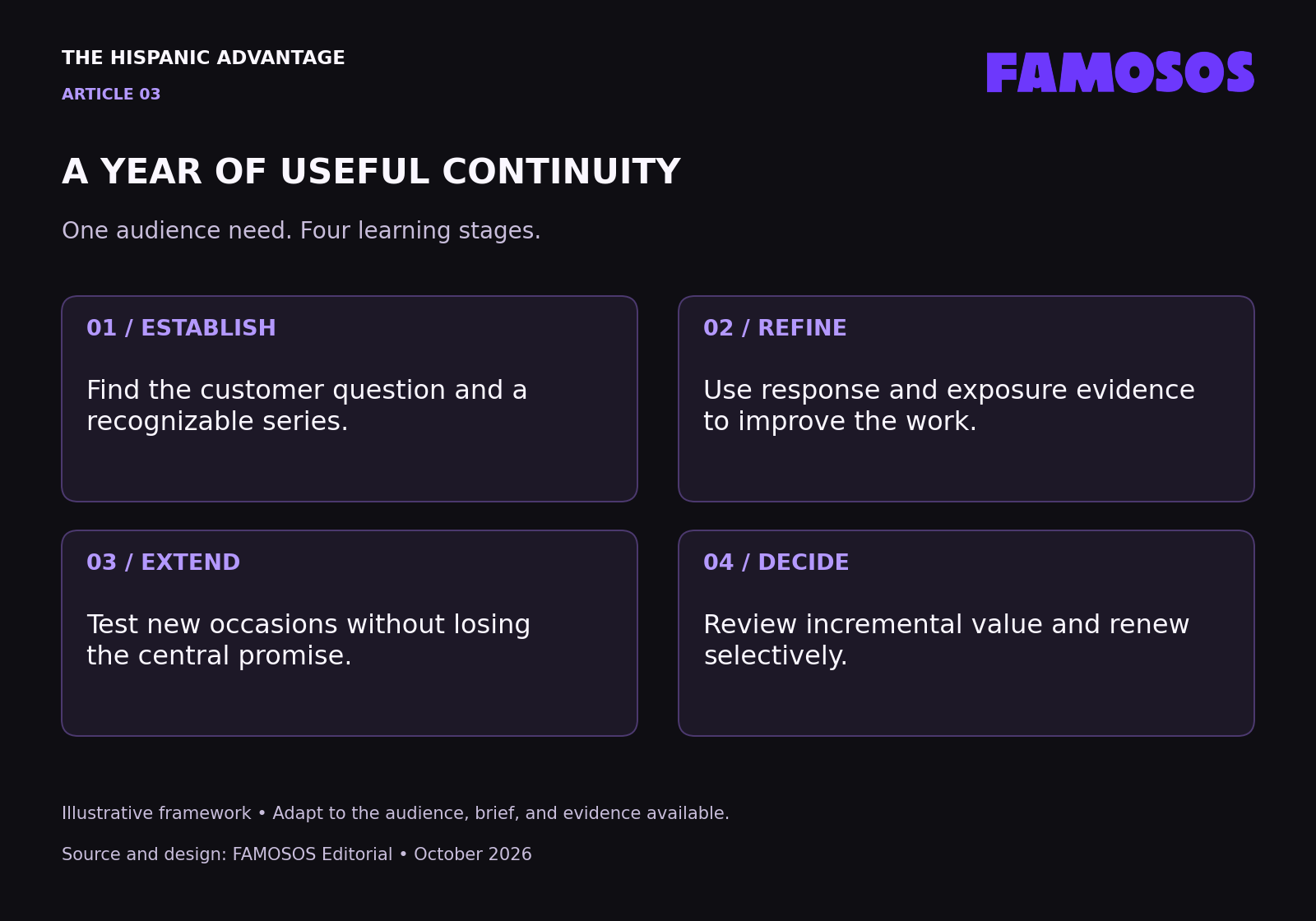
Maintain a small learning log across those stages: the hypothesis, audience definition, creative version, dates, spend, delivery, outcome, and next action. Record operational changes such as stockouts or pricing promotions. Otherwise a team may credit an execution for a change caused elsewhere.
Build room for relevant cultural moments without making every month a themed campaign. Participation should follow audience interest and the product’s role. A calendar is an organizational tool; cultural understanding determines whether a moment belongs in the plan.
Create relationships that can develop over time
A recurring creator partnership can give a series continuity while allowing the creative to develop. These three FAMOSOS creators suggest different recurring content jobs. These are proposed applications of content categories in the FAMOSOS roster, not descriptions of commissioned work or verified campaign results. Confirm current content, audience analytics, and availability before selection. Roster reference.
Ale De la Torre: follow the routine
WHY IT MATTERS
Ale’s home, family, beauty, and lifestyle categories suggest a series built around everyday household decisions. A home brand could propose successive episodes on choosing, using, and organizing one product. The commercial opportunity is to answer different questions over time while keeping the product’s role recognizable. Invite the creator to identify the situations that feel natural to her current content. Compare completion and qualified product visits across episodes, then investigate whether later exposure improves understanding. Do not assume that a family content category establishes the household composition or purchase behavior of everyone watching.
Feliz de compartir esta nueva etapa de mi vida con ustedes!! 💕💕
Watch on TikTok ↗Mari Gutierrez: develop the use occasion
WHY IT MATTERS
Mari’s food, cooking, fitness, and lifestyle categories could support an ongoing series about practical ways to use a food product. Each installment might address a different preparation question or occasion. Keep product and nutrition statements accurate, and avoid turning a lifestyle association into a health claim. The useful test is whether viewers gain a clearer reason to consider the product and return for another relevant idea. Track recipe interest, qualified destination visits, and purchases where measurement permits. A consistent format becomes valuable when it continues to answer questions, rather than simply repeating the same promotional message.
Cuidar de ti te fortalece en todos los sentidos😍🐦🔥✨ #selflove
Watch on Instagram ↗Luz Vero Solis: build a seasonal sequence
WHY IT MATTERS
Luz’s running, fitness, education, family, and lifestyle categories suggest a sequence around preparing for different activity occasions. An apparel brand could explore choosing a product, using it in an appropriate setting, and explaining care afterward. This creates several useful product stories without requiring an unsupported performance promise. Ask the creator which questions recur in her audience and verify the target-market fit before commissioning the series. Measure understanding, qualified visits, and repeat engagement with comparable definitions across episodes. Treat those signals as learning inputs; incremental revenue still requires a suitable commercial comparison.
Wedding vibes 👸🏻🤠🤠🤠🤠 @Luzveroo ✨ #paratiii #fyp #mexico #wedding #fashion
Watch on TikTok ↗Measure trust and growth as separate outcomes
Define trust in terms a study can actually ask about: reliability, credibility of product information, or confidence that the brand understands a particular need. Repeat the same questions with comparable samples. Comments can reveal useful objections, but enthusiastic comments are not a representative trust survey.
For business impact, decide before launch whether the question concerns the entire program or one creative element. Google’s lift guidance distinguishes brand, search, and conversion outcomes measured through controlled comparisons. Use a method suited to the intervention and the scale available.
Source: Google Ads Help — About lift studies.
A year-over-year sales increase alone cannot isolate the program’s contribution. Price, distribution, competitors, and seasonality may also change. Where feasible, use randomized holdouts; otherwise design a credible geographic comparison and state its limitations. Keep the sales window long enough for the category, and include creator, production, media, rights, management, and measurement costs.
Always-on should still have decision points. Review delivery regularly, creative learning by wave, and commercial contribution at an agreed interval. Retain creators and formats when the evidence supports them. Pause or redesign when the customer need, distribution, or economics no longer justify the investment. Consistency works best when it accumulates knowledge rather than obligations.
What this means for your brand
Choose one recurring customer need and fund a sequence of useful answers. Give the program an owner, a manageable creator roster, and a shared record of what each wave teaches. Review reach, exposure distribution, customer response, and incremental contribution on an agreed schedule. Continue the elements that remain useful, refresh those that tire, and expand only when the evidence supports the additional investment.
- Strategy & Growth
- U.S. Hispanic Marketing
- Creator Marketing
- FAMOSOS
About the author
FAMOSOS Editorial
Editorial Team
The Hispanic Advantage is written by the FAMOSOS team — creator strategists and multicultural marketers working with U.S. Hispanic creators every day.
Your next Hispanic advantage starts here.
Get creator strategies, cultural insights, and market intelligence from FAMOSOS.
Keep reading

Strategy & Growth5 min read
Hispanic Influencer Marketing: How to Build a Strategy That Drives Results
Connect a business objective to audience insight, creator selection, an original brief, distribution, and measurement before commissioning the first post.

Strategy & Growth7 min read
Why Your Brand Needs a Dedicated U.S. Hispanic Marketing Strategy: More Impact, Stronger ROI
A dedicated U.S. Hispanic strategy connects audience insight, creative, creators, and measurement. Here is how to build the business case and test the return.
Strategy & Growth7 min read
U.S. Hispanic Marketing: The Complete Guide for Brands
A practical guide to the U.S. Hispanic opportunity: market size, consumer spending, language, creators, measurement, and a 90-day plan for brands.