
Why Your Brand Needs a Dedicated U.S. Hispanic Marketing Strategy: More Impact, Stronger ROI
A dedicated U.S. Hispanic strategy connects audience insight, creative, creators, and measurement. Here is how to build the business case and test the return.
· Updated · 7 min read

A brand can reach Hispanic consumers through its national media plan and still leave important growth questions unanswered. Which shoppers are being missed? What makes the product useful in their lives? Does the message give them a reason to choose it?
A dedicated U.S. Hispanic marketing strategy gives those questions an owner, a budget, and a learning agenda. Stronger ROI is the objective. Achieving it depends on audience fit, creative quality, distribution, and the economics of the customer relationship.
1. Define the business opportunity before the campaign
The U.S. Census Bureau estimates that 70.1 million Hispanic people lived in the United States on July 1, 2025, representing 21% of the population. Its August 2026 release establishes the scale of the audience; your category and customer data establish the opportunity for your brand.
Start with a segment you can describe operationally: category buyers in markets you serve, facing a specific purchase barrier. Check product availability, affordability, usage occasions, language behavior, and the experience after the click. National origin, age, and household context can inform research without becoming shortcuts for predicting an individual’s preferences.
Write the objective as a customer behavior: increase first purchases, qualified applications, repeat orders, or consideration among eligible buyers. Then decide how a dedicated program could help.
Source: U.S. Census Bureau — National Hispanic Heritage Month: 2026.
2. Build the strategy from the ground up
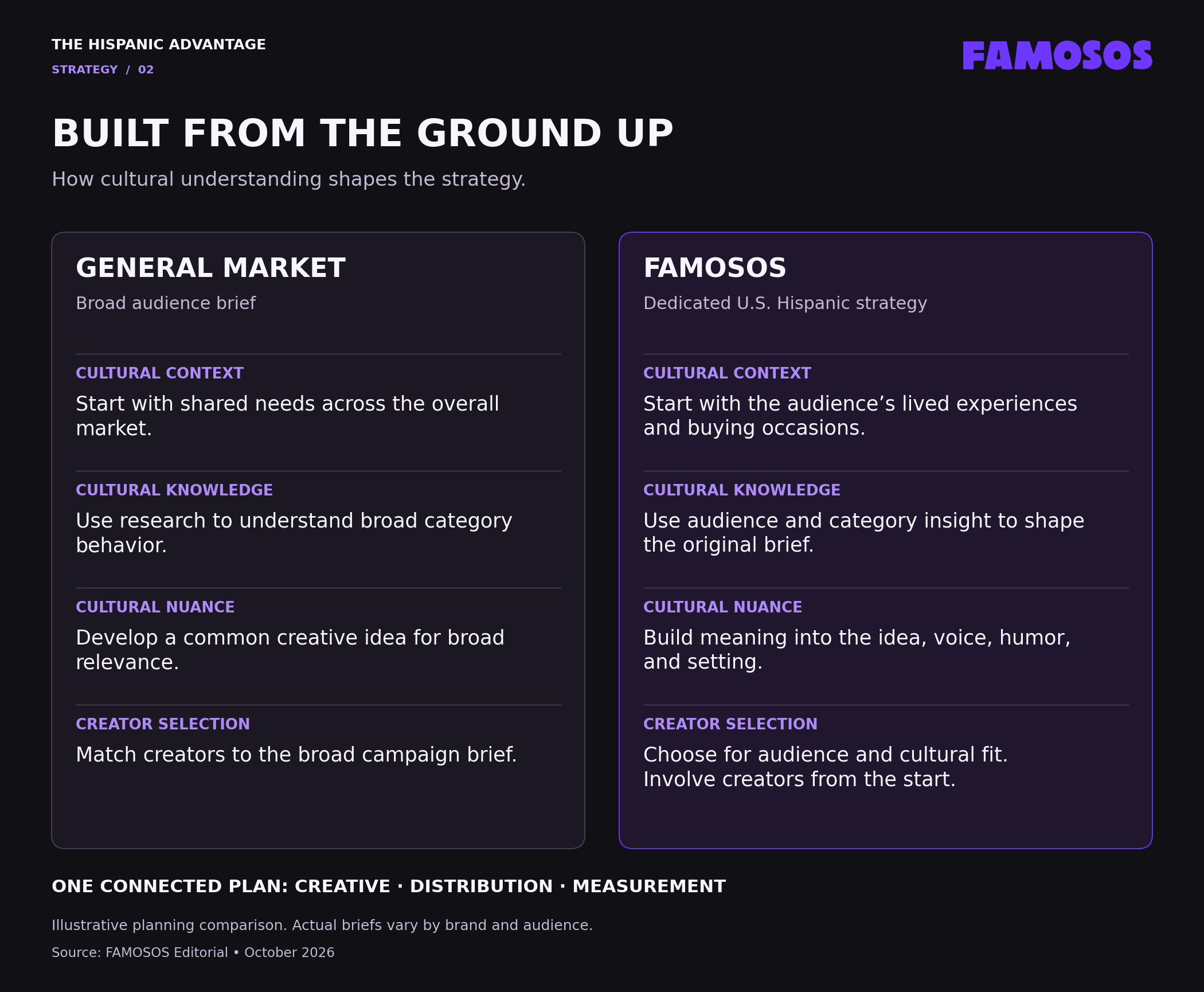
FAMOSOS builds U.S. Hispanic strategies from the ground up. Cultural context, cultural knowledge, cultural nuance, and creator selection shape the original brief and creative idea.
Cultural context identifies the situations in which the product could matter. Cultural knowledge brings research and audience understanding into the brief. Cultural nuance informs meaning, humor, voice, and setting. Creator selection connects those choices with people whose content and audience fit the objective, involving them early enough to help shape the work.
These decisions can support the brand’s wider positioning while producing ideas developed for a defined audience. English, Spanish, or a combination follows the audience evidence. Creative, distribution, and measurement then form one connected plan.
| Strategic foundation | General-market starting point | FAMOSOS: built from the ground up |
|---|---|---|
| Cultural context | Start with shared needs across the overall market. | Start with the audience’s lived experiences and buying occasions. |
| Cultural knowledge | Use research to understand broad category behavior. | Use audience and category insight to shape the original brief. |
| Cultural nuance | Develop a common creative idea for broad relevance. | Build meaning into the idea, voice, humor, and setting. |
| Creator selection | Match creators to the broad campaign brief. | Choose for audience and cultural fit. Involve creators from the start. |
3. Build a credible path from relevance to return
The commercial logic has three parts. Audience planning can improve the chance of reaching eligible buyers. Relevant creative can make the product’s role easier to understand. A consistent landing page, retail experience, and offer can help interested people act. Each is a hypothesis to test.
Historical evidence makes the case for investigating. Nielsen’s May 2021 study, commissioned by Univision, compared U.S. consumer packaged goods advertisers using 2018–2019 data. Brands with above-category-average shares of TV spending on Spanish-language networks had reported average ROAS of $4.49, versus $2.59 for the lower-share group. The study defined ROAS as incremental revenue divided by TV advertising spend.
This was a comparison across groups of brands, rather than a randomized test of a single brand’s strategy. It supports examining media allocation; it does not isolate the effect of language or predict a creator campaign’s return. Use it to justify a well-designed test, with current economics and an appropriate comparison.
Source: Nielsen — The ROI of Inclusivity.
FAMOSOS reports that a FAMOSOS-led dedicated U.S. Hispanic strategy delivers, on average, 3–4× the impact of a general-market approach. This company-reported benchmark was supplied by founder and CEO Andres in October 2026. It is an impact claim, not an independently verified ROI multiple. Define the impact metric and comparison for your campaign before using the benchmark in a forecast.
4. Learn from two public food-brand cases
These publicly available award submissions are comparable as examples of cultural insight applied to everyday food categories. Their budgets, periods, and measurement methods differ, so their outcomes cannot be ranked as competing ROI results. Both are external examples, credited to the agencies named in the submissions.
NESCAFÉ Clásico: adapt the occasion.
In its 2021 case submission, Casanova//McCann described revising NESCAFÉ’s 2020 message when pandemic restrictions changed how people could gather. The work reframed coffee at home around connection with those closest to the consumer. The submission reported 11% growth in total NESCAFÉ brand sales and nearly two million new households.
The strategic lesson is responsiveness: an established audience strategy should evolve when the customer’s circumstances change. The reported sales growth is a business outcome, but the public case does not isolate the campaign’s incremental contribution through a controlled comparison.
Mahatma and Carolina: make the product part of self-expression.
Alma DDB’s 2023 Riviana case described “Unfollow La Receta,” an approach aimed at younger Latino consumers interested in reinterpreting traditional dishes. The plan connected the creative idea with social, online video, audio, local outdoor media, and an e-commerce destination. The submission reported 1.8 million website visitors against a one-million goal.
The lesson is integration: let the audience insight influence both the story and the next step. Website traffic shows response to the program; judging profitability would also require conversion, margin, cost, and incrementality evidence.
5. Give creators a specific strategic job
A creator brief should identify what the audience needs to understand, feel, or do. These three FAMOSOS creators illustrate different roles across consumer and business categories. The concepts below are proposed applications based on their supplied content categories, with audience fit to be established for each campaign.
Danny Fitt: make the benefit memorable
Danny’s comedy, family, and gaming categories suggest a brief that makes a product benefit part of an entertaining situation. A consumer technology brand could explore a short sketch around an everyday interruption, followed by a demonstration of the feature that addresses it.
WHY IT MATTERS
The creative job is to connect an enjoyable moment with a benefit viewers can remember. Give the creator ownership of the setup and delivery, while keeping the feature accurate and the brand’s role clear. Compare the concept with a straightforward product explanation among comparable audiences. Evaluate brand linkage and qualified visits or completed activations alongside engagement.
Instagram profile: https://instagram.com/danny.fitt
Antonia Botero: demonstrate everyday product fit
Antonia’s beauty, fashion, and lifestyle positioning suggests a concept that shows how a product fits different everyday occasions. A fashion brand could explore one item styled for two situations, with the creator explaining the choices that make each version useful.
WHY IT MATTERS
Demonstration gives the audience concrete information for a purchase decision: how an item works, where it fits, and why it might be worth considering. Build the brief around an actual customer question and allow the creator to choose the setting and presentation. Assess product understanding and qualified product-page visits, then examine purchases with an appropriate comparison. Avoid treating saves or comments alone as evidence of incremental sales.
Instagram profile: https://www.instagram.com/antoniaboterob
Ivonne Kinser: help the audience evaluate a decision
Ivonne’s business, entrepreneurship, education, and technology categories suggest a brief built around a considered decision. For a business software brand, a proposed concept could walk through one workflow, explain the problem it addresses, and identify the questions a prospective customer should ask.
WHY IT MATTERS
Useful explanation can give a buyer a clearer basis for evaluating the product. Supply accurate demonstrations and evidence for product claims, then let the creator shape the explanation. Match the destination to the decision stage: a useful guide, product trial, or qualified inquiry. Measure understanding and lead quality, and follow those leads through the sales cycle before assessing return.
Instagram profile: https://www.instagram.com/ivonnekinser/
6. Choose your starting point
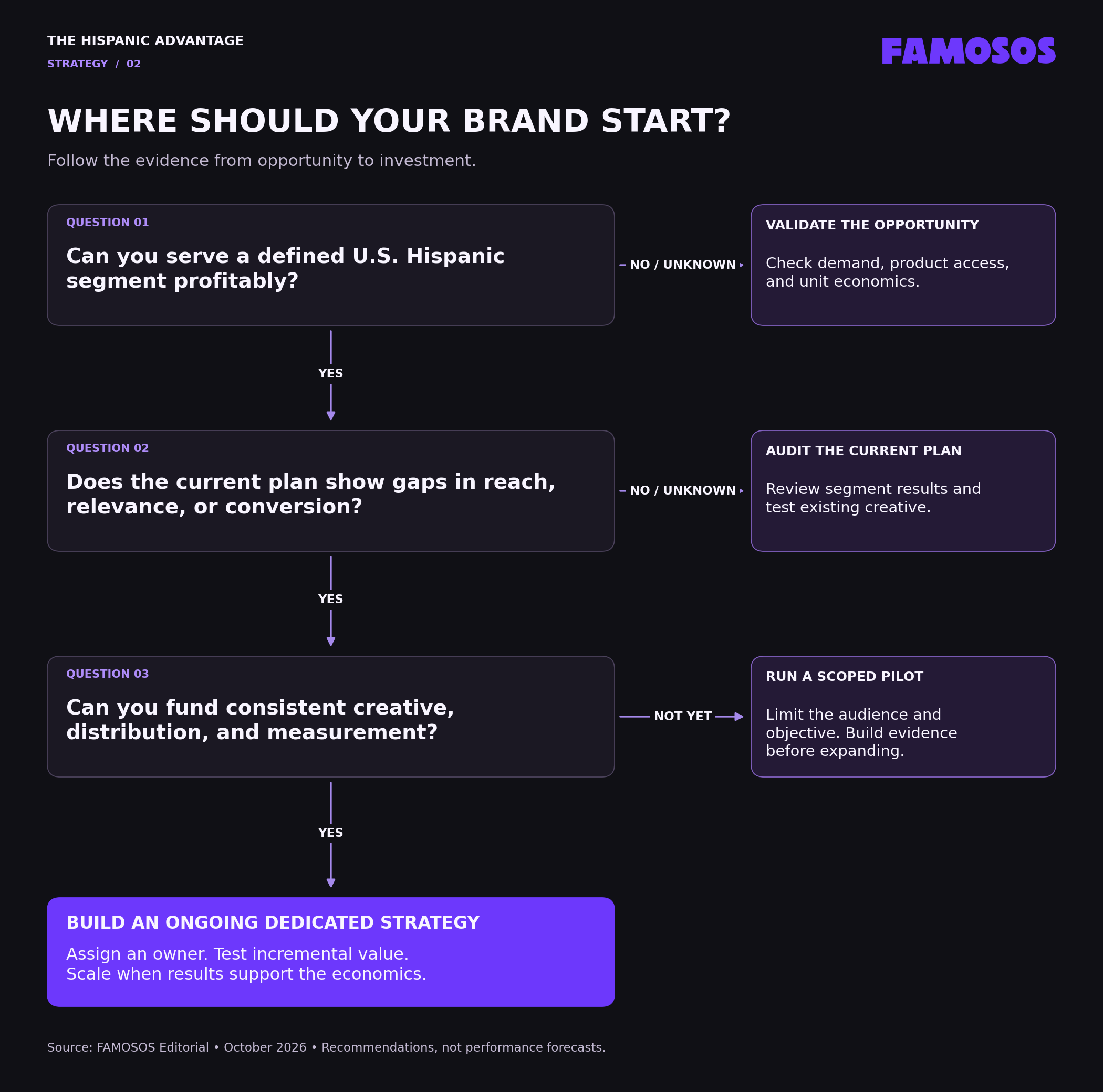
Use the decision tree to match ambition with readiness. Confirm you can serve the audience, identify what the current plan leaves unresolved, and decide whether you have the resources to learn consistently. A focused pilot can establish those conditions before a larger commitment.
7. Measure the contribution, then decide what to scale
Design the comparison before launch. To isolate a creative effect, compare executions among comparable eligible audiences while keeping the offer, timing, and distribution conditions as consistent as possible. A test of the whole strategy may change several elements; interpret its result as the combined effect.
Use randomized holdouts where feasible, or a carefully designed geographic test. Google’s lift guidance distinguishes brand, search, and conversion lift, including user-based and geographic conversion studies. Choose the method for the decision, with enough scale and time to detect a commercially meaningful difference.
Source: Google Ads Help — About lift studies.
| Question | Useful measure | Decision supported |
|---|---|---|
| Did we reach intended buyers? | Qualified reach and incremental reach | Audience and distribution choices |
| Did the message work? | Comprehension, brand linkage, or consideration lift | Creative and briefing choices |
| Did behavior change? | Incremental purchases or qualified completed actions | Program effectiveness |
| Did the economics work? | Incremental contribution after all program costs | Budget expansion or redesign |
Use a consistent profit definition:
Incremental marketing ROI = (incremental contribution before marketing − total program cost) ÷ total program cost.
Calculate contribution after product and variable fulfillment costs. Include creator fees, production, usage rights, paid media, agency work, and measurement in program cost. ROAS uses revenue and advertising spend; it answers a different financial question. Report uncertainty, and agree on scale, revise, or stop criteria before seeing the results.
8. Give the strategy an operating rhythm
Start with a 90-day learning plan, adjusted to your sales cycle. In the first month, define the audience, customer barrier, baseline, and test design. In the second, launch a manageable set of creative ideas and check delivery and customer friction. In the third, evaluate what the evidence supports and commission the next iteration.
Keep a named owner and a recurring review with creative, media, and commercial teams. Consistency gives the program a way to accumulate learning across briefs and buying occasions. Expand when the audience response and unit economics support the decision.
What this means for your brand
Give U.S. Hispanic growth a named owner, a defined audience, and a funded learning plan. Start with one commercially meaningful barrier in markets you can serve, then test relevant creative and creators against your current approach. Keep the offer and measurement window comparable, include the full program cost, and use incremental contribution to guide expansion. Continue investment where the evidence supports it, and use each test to improve the next brief.
- U.S. Hispanic Marketing
- Marketing Strategy
- Cultural Relevance
- Creator Marketing
- Marketing ROI
About the author
FAMOSOS Editorial
Editorial Team
The Hispanic Advantage is written by the FAMOSOS team — creator strategists and multicultural marketers working with U.S. Hispanic creators every day.
Your next Hispanic advantage starts here.
Get creator strategies, cultural insights, and market intelligence from FAMOSOS.
Keep reading

Strategy & Growth5 min read
Hispanic Influencer Marketing: How to Build a Strategy That Drives Results
Connect a business objective to audience insight, creator selection, an original brief, distribution, and measurement before commissioning the first post.
Strategy & Growth5 min read
The Power of Consistency in U.S. Hispanic Marketing: How Always-On Strategies Build Trust and Drive Growth
Build a year-round Hispanic marketing program that connects useful creative, recurring creator relationships, audience learning, and measurable business decisions.

Strategy & Growth7 min read
U.S. Hispanic Marketing: The Complete Guide for Brands
A practical guide to the U.S. Hispanic opportunity: market size, consumer spending, language, creators, measurement, and a 90-day plan for brands.