
Hispanic Influencer Marketing: How to Build a Strategy That Drives Results
Connect a business objective to audience insight, creator selection, an original brief, distribution, and measurement before commissioning the first post.
· Updated · 5 min read

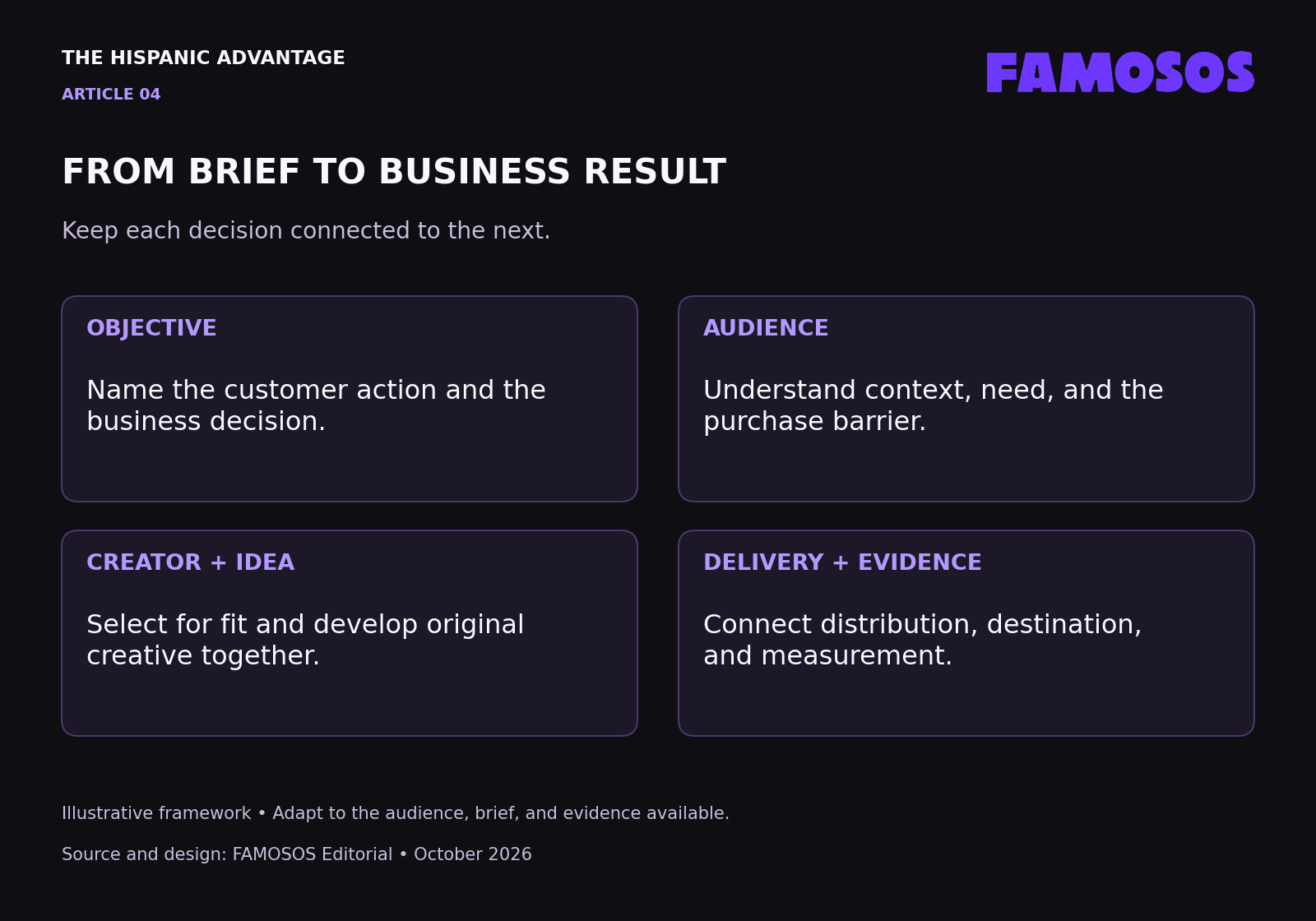
A strong Hispanic influencer marketing strategy makes a series of connected choices. Who is the customer? What stands between that person and a useful action? What can a creator make clearer, more credible, or more relevant? How will the brand know the work helped?
The strategy becomes weaker when those choices are made in separate rooms. A recognizable creator cannot compensate for an unavailable product, a vague brief, or a destination that loses interested buyers. Build the program as one customer experience.
Start with the business decision
Choose one primary outcome: first purchase, qualified trial, store visit, application completion, or a measurable change in consideration. Set a time horizon that matches how people buy. A low-consideration product and a complex service should not inherit the same conversion window.
IAB’s November 2025 report projected U.S. creator advertising spend of $37 billion for 2025 and identified creator selection and measurement among the industry’s challenges. That is evidence of industry investment and unresolved operating questions, not a Hispanic-specific effectiveness benchmark.
Source: IAB — 2025 Creator Economy Ad Spend & Strategy Report.
Translate the objective into a decision rule before commissioning content. For example: continue a product-education pilot if it improves comprehension and generates qualified traffic at an economically acceptable cost. If the pilot is too small to measure incremental sales reliably, say which earlier decision it can support. Avoid making a sales promise that the design cannot evaluate.
Build the audience brief from the ground up
Define eligible buyers in markets the brand can serve. Investigate the category need, buying occasion, perceived trade-offs, and preferred information sources. National origin, language use, age, and life stage can guide questions; none replaces evidence about the actual customer.
FAMOSOS brings cultural context, cultural knowledge, cultural nuance, and creator selection into the original strategy. Context identifies where the product matters. Knowledge informs the audience and category problem. Nuance shapes tone, meaning, humor, and setting. Creator selection connects those decisions to a suitable voice and audience.
Bring potential creators into concept development early. Ask what would feel natural, what the audience would challenge, and which part of the product needs a demonstration. A useful brief protects the business objective while leaving creative decisions with the people best equipped to make them.
Use a brief that connects the whole journey
| Brief element | Example decision |
|---|---|
| Customer | U.S. shoppers in stocked markets seeking convenient evening meal options. |
| Barrier | Uncertainty about preparation and product versatility. |
| Creator job | Show one credible use occasion and answer one preparation question. |
| Creative freedom | Creator chooses the setting, voice, and demonstration structure. |
| Required facts | Accurate preparation steps, availability, sponsorship disclosure, and product claims. |
| Next action | Visit a fast recipe page with an accurate retailer or purchase route. |
| Measurement | Comprehension, eligible destination visits, and a preplanned sales comparison if feasible. |
Give each creator a specific job
A creator shortlist should explain the contribution each person could make to the brief. These three FAMOSOS creators illustrate different jobs. These are proposed applications of content categories in the FAMOSOS roster, not descriptions of commissioned work or verified campaign results. Confirm current content, audience analytics, and availability before selection. Roster reference.
Orlando Turcios: make the use case understandable
WHY IT MATTERS
Orlando’s cooking, comedy, and lifestyle categories suggest a product demonstration with an entertaining setup. A food brand could explore a familiar preparation problem followed by a clear solution using the product. The brand’s task is to preserve accurate instructions and a recognizable product role while letting the creator develop the delivery. Evaluate whether viewers understand the use case, not simply whether the joke attracts attention. Use qualified recipe visits and a comprehension question alongside viewing metrics. Audience geography and category fit should be verified before this proposed concept becomes a commissioning decision.
Demasiado flow para una sola pareja. 😏🔥@La Familia Lopez @Leduar Lopez
Watch on TikTok ↗Eixchel: make product choice easier
WHY IT MATTERS
Eixchel’s beauty, fashion, entertainment, and skincare categories suggest a brief that helps viewers compare practical product features. A beauty brand could propose a demonstration of application or finish under clearly described conditions. Keep evidence and claims specific, and avoid implying an effect the product cannot substantiate. Invite the creator to choose a presentation consistent with current content. Measure whether viewers can identify the demonstrated benefit and whether visits reach relevant product information. This gives creative review a useful question: did the execution clarify the decision the customer actually faces?
Michelle Posada: explain a considered decision
WHY IT MATTERS
Michelle’s business, entrepreneurship, podcast, and lifestyle categories suggest an explanatory format for a more involved purchase. A business tool could be introduced through one concrete workflow and the trade-offs a prospective customer should consider. The idea should demonstrate a real capability, rather than rely on an abstract endorsement. Let the creator shape the questions and language while the brand verifies product details. Track qualified inquiries or trial activation, then follow their quality through the sales process. Views alone would not show whether the content helped the intended buyer evaluate the offer.
Budget for the work after the post
Creator fees are one part of the investment. Define production needs, revision rounds, usage term, paid amplification, exclusivity, and measurement before comparing proposals. Determine who owns the destination, checks availability, answers comments, and fixes broken links.
Plan organic and paid distribution together while reporting them separately. Organic response can help identify promising creative; it is not a clean causal test because delivery is selective. Paid tests can create more comparable conditions when audiences, offers, placements, and timing are controlled.
Build sponsorship disclosure into the creative brief. FTC guidance calls for a clear disclosure of material brand relationships with the endorsement itself; video disclosures belong in the video, not only its description. Make the disclosure part of approval and final asset review.
Source: Federal Trade Commission — Disclosures 101 for Social Media Influencers.
Measure the question you actually asked
Use delivery metrics to diagnose exposure, content measures to diagnose understanding, and commercial measures to evaluate customer action. Keep a consistent definition of a qualified visit or lead across creators. Deduplicate purchases and identify where a code or link may miss other purchase paths.
To estimate incremental impact, use an appropriate comparison. Google’s lift documentation explains controlled studies for brand, search, and conversion outcomes. Select a design with enough scale to answer the business question, and distinguish the combined program effect from the effect of a single creator.
Source: Google Ads Help — About lift studies.
Close the pilot with a decision, not a collection of screenshots. Document which hypothesis held up, where the journey broke down, what remains uncertain, and what the next wave should test. A creator may succeed at education while the offer fails to convert; another may generate many visits that do not meet the customer criteria. Those findings should lead to different changes.
The result is a strategy the team can improve. Audience insight informs the brief, the brief defines the creator’s job, and measurement determines where further investment has a credible purpose.
What this means for your brand
Turn your next creator request into a decision-ready brief: a specific customer, purchase barrier, action, destination, and measurement plan. Select creators only after defining what they must help the audience understand or do. Preserve room for their creative judgment while specifying accurate product claims and delivery requirements. Evaluate qualified customer response and incremental contribution before expanding the program.
- Strategy & Growth
- U.S. Hispanic Marketing
- Creator Marketing
- FAMOSOS
About the author
FAMOSOS Editorial
Editorial Team
The Hispanic Advantage is written by the FAMOSOS team — creator strategists and multicultural marketers working with U.S. Hispanic creators every day.
Your next Hispanic advantage starts here.
Get creator strategies, cultural insights, and market intelligence from FAMOSOS.
Keep reading
Strategy & Growth5 min read
The Power of Consistency in U.S. Hispanic Marketing: How Always-On Strategies Build Trust and Drive Growth
Build a year-round Hispanic marketing program that connects useful creative, recurring creator relationships, audience learning, and measurable business decisions.

Strategy & Growth7 min read
Why Your Brand Needs a Dedicated U.S. Hispanic Marketing Strategy: More Impact, Stronger ROI
A dedicated U.S. Hispanic strategy connects audience insight, creative, creators, and measurement. Here is how to build the business case and test the return.

Strategy & Growth7 min read
U.S. Hispanic Marketing: The Complete Guide for Brands
A practical guide to the U.S. Hispanic opportunity: market size, consumer spending, language, creators, measurement, and a 90-day plan for brands.