
U.S. Hispanic Marketing: The Complete Guide for Brands
A practical guide to the U.S. Hispanic opportunity: market size, consumer spending, language, creators, measurement, and a 90-day plan for brands.
· Updated · 7 min read

A brand can reach Hispanic consumers every day and still leave an important question unanswered: does its marketing reflect how those consumers actually choose, buy, and use the product?
U.S. Hispanic marketing is the discipline of answering that question deliberately. It connects audience research, cultural context, language, creators, distribution, and measurement to a specific business objective.
For a CMO, the opportunity begins with scale. The advantage comes from deciding where to focus, what to say, who should say it, and how to earn the next purchase. This guide provides a practical starting point.
1. Size the opportunity, then define the audience
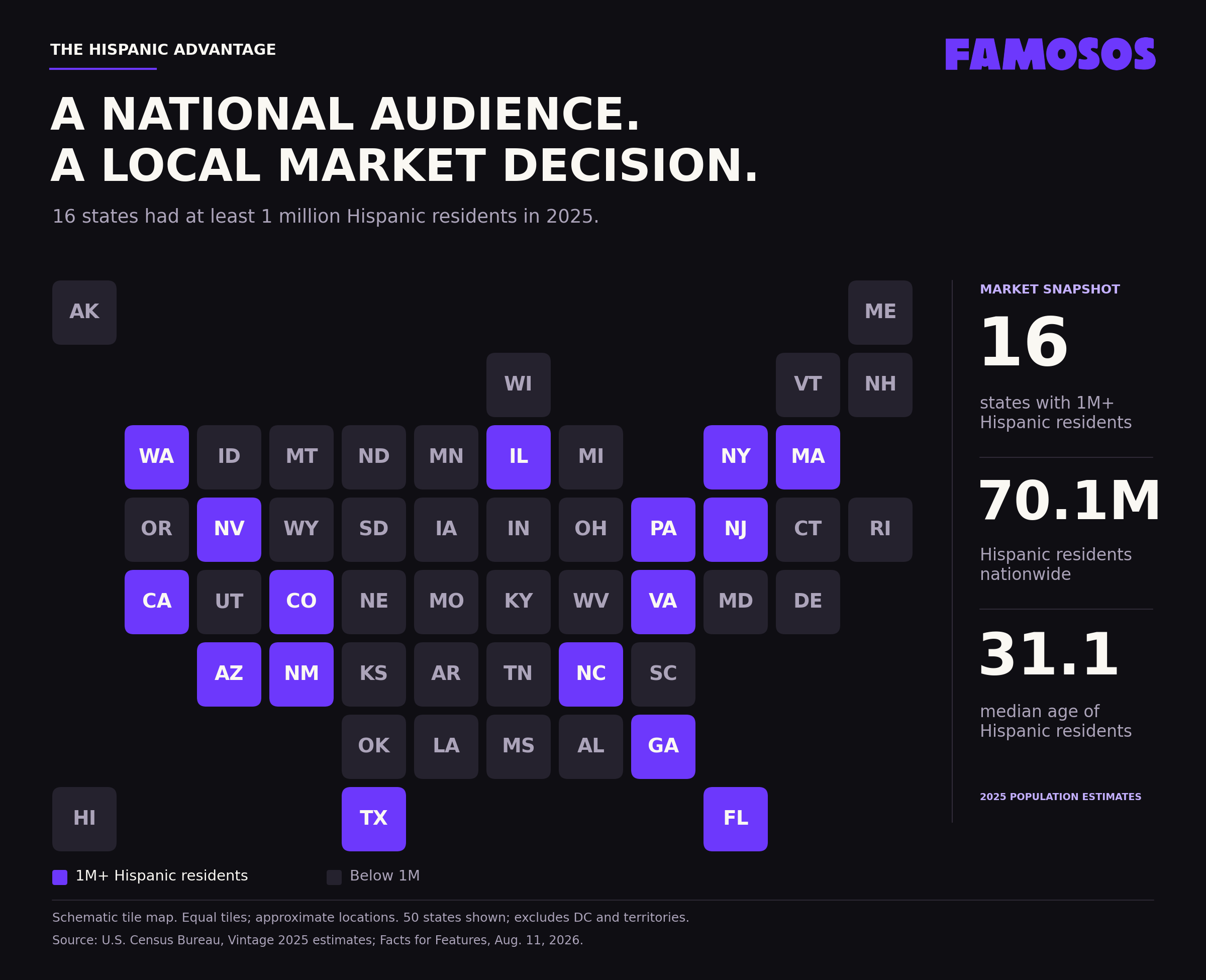
The U.S. Census Bureau estimated 70.1 million Hispanic residents as of July 1, 2025. Their median age was 31.1. These figures establish the scale of the audience; they do not describe a single customer.
The Census category includes people of different racial identities and origins. For brand planning, go further: separate geography, life stage, income, category behavior, language use, and the cultural contexts relevant to the purchase.
A Mexican American parent buying groceries, a Puerto Rican college student comparing mobile plans, and a Colombian American entrepreneur choosing business software are different briefs. These are illustrative customers, not claims about what those communities buy.
Start with a precise question: which Hispanic consumers can this brand serve better, and what is preventing them from choosing it today?
Sources: U.S. Census Bureau, published August 11, 2026; population reference year 2025: https://www.census.gov/newsroom/facts-for-features/2026/hispanic-heritage-month.html
U.S. Census Bureau, Hispanic Origin: https://www.census.gov/topics/population/hispanic-origin.html
2. Choose markets where audience and availability meet
In 2025, 16 states each had at least one million Hispanic residents: Arizona, California, Colorado, Florida, Georgia, Illinois, Massachusetts, Nevada, New Jersey, New Mexico, New York, North Carolina, Pennsylvania, Texas, Virginia, and Washington.
Use that footprint to start the analysis. Then narrow it with metropolitan and neighborhood data, retail distribution, service eligibility, existing customers, and competitive intensity. A large audience has limited commercial value if the product is unavailable where people live or shop.
Use Census population estimates for scale and American Community Survey profiles for local characteristics such as language, household composition, and income. Record the year and geography, and check margins of error before treating small differences as meaningful.
Source: U.S. Census Bureau, August 11, 2026; 2025 estimates: https://www.census.gov/newsroom/facts-for-features/2026/hispanic-heritage-month.html
3. Translate market size into category opportunity
Population is only one input. A useful commercial brief also asks how much the relevant consumers spend in the category, which occasions drive demand, and where the brand can win.
The Bureau of Labor Statistics’ 2024 Consumer Expenditure data provide a concrete baseline. Consumer units whose reference person was Hispanic or Latino averaged $69,600 in annual expenditures, including the categories below.
| Category | Average annual expenditure |
|---|---|
| Housing | $25,496 |
| Transportation | $13,285 |
| Food | $10,013 |
| Healthcare | $4,028 |
| Entertainment | $2,407 |
A consumer unit can be a family, an individual, or people who share major expenses. These are averages per consumer unit, not spending per Hispanic individual, and the selected categories do not sum to total expenditure.
Use the figures to frame category research. For a food brand, investigate meals, retailers, price points, and preparation habits. For a financial service, investigate the specific task, eligibility, trust barriers, and onboarding experience. Total spending is not the same as your addressable market.
4. Make language a strategic choice
The right language depends on the audience, the occasion, and the task. Research how customers discover products, discuss them, seek help, and complete a purchase. Those moments may call for different language choices.
Nielsen’s 2026 Hispanic report found that Spanish-language television accounted for 42% of Hispanic linear TV viewing time in the first half of 2026. That is a finding about linear television, not a universal preference across social media, shopping, or every Hispanic consumer.
For creators, test Spanish, English, or a natural bilingual approach when the audience evidence supports it. Give each version an appropriate hook and context. Review captions, landing pages, customer support, and checkout together: a strong Spanish-language ad can lose its value when the next step is confusing.
Source: Nielsen, 2026 Diverse Intelligence Series; measurement period: first half of 2026. https://www.nielsen.com/insights/2026/hispanic-dis-report/
5. Choose creators for their role in the decision
Select creators around the job the content must do: introduce the brand, demonstrate a product, explain a difficult process, or make an everyday experience recognizable.
Review audience geography, relevant age groups, content language, category credibility, and recent performance. Ask for platform analytics when those details matter. A creator’s identity, name, or follower count does not establish the makeup of their audience.
The following FAMOSOS Management creators illustrate three different creative roles. Their listed categories help establish an initial fit; the specific audience and business objective should guide the final selection. The suggested applications below are editorial recommendations, not descriptions of existing campaigns.
Explore FAMOSOS Management: https://famosos.com/management
Alex Serrano — connect food with a specific occasion.
Alex’s categories include food, comedy, and travel. For a food or beverage brand, that combination offers a starting point for a brief built around a dish, a place, or a discovery.
The lesson for marketers: give the product a clear role in the experience. A creator could introduce a local food occasion, explain what makes it distinctive, and show where the brand fits. Validate audience geography before assuming cultural relevance translates into U.S. customer reach.
Instagram profile: https://www.instagram.com/alexserrano1/
La Familia Lopez — give the product a believable role.
La Familia Lopez’s categories include comedy, cooking, lifestyle, sports, and travel. Those categories create several possible routes into everyday purchase occasions.
A grocery or household brand could brief a cooking scenario or a relatable moment with a clear product role. The lesson is to define the situation and benefit, then let the creator shape the storytelling. Humor should help the audience understand the idea without overwhelming the message.
Instagram profile: https://www.instagram.com/lafamilia_lopez/
Dunia Santos — make the next step easier to understand.
Dunia’s categories include education, lifestyle, and entrepreneurship. For a service brand, that positioning suggests an opportunity to explore content that answers a practical customer question.
The lesson for marketers: choose one barrier to address, such as understanding how a service works or what happens after registration. Give the creator accurate information and a clear next action. Treat this as a proposed creative approach; verify subject relevance and audience fit before commissioning the content.
Instagram profile: https://www.instagram.com/dunia_santos_urbina
Dios es mi guia 🤍🪖
Watch on TikTok ↗Why it matters
Representation is the hook. Dunia frames this moment around contributing ideas and representing Latinos. That framing connects a personal experience to a broader question: whose perspective gets heard? For marketers building a U.S. Hispanic strategy, the lesson is to involve creators in shaping the message. Ask which questions, ambitions, or concerns matter to their specific audience, and give them room to explain the connection in their own voice. A brand’s contribution should be concrete: useful information, access to a resource, or an opportunity to participate. Apply this by selecting creators for audience fit and subject relevance, then defining what viewers should understand or do next. Evaluate message comprehension and qualified actions alongside engagement.
6. Build consistency into the operating plan
An ongoing program gives a brand repeated opportunities to learn: which questions recur, which explanations help, and which creators can tell the next chapter. That is the practical case for consistency.
Start with a manageable creator group and recurring content themes. Add relevant seasonal moments where they fit the category, then use paid amplification to distribute selected content to defined audiences. Agree on usage rights, revisions, approvals, and measurement access before production.
Build the budget from the work required: creator fees, production, usage rights, paid media, measurement, and campaign management. Protect enough investment for distribution and learning after the first content goes live.
Set the cadence around the purchase cycle and available resources. There is no universal posting frequency or automatic return multiplier. A subscription service, a grocery brand, and a durable-goods manufacturer need different plans.
7. Measure the business question
Choose the primary success metric before selecting the roster. An awareness program might prioritize qualified reach and brand lift. A consideration program might track qualified visits, product exploration, or retailer searches. An acquisition program should track completed purchases or qualified customers and their acquisition cost.
Report organic and paid results separately, then explain how they worked together. Impressions count exposures; reach counts people or accounts under the platform’s definition. Adding platform reach totals does not produce a deduplicated audience.
For acquisition, define whether CAC includes media alone or the full program cost. Use consistent attribution windows when comparing creative versions. Where feasible, use holdouts or comparable markets to estimate incremental impact. Click attribution alone cannot establish that a sale would not have happened otherwise.
8. Put the first 90 days to work
Treat the first cycle as a structured test with a clear expansion decision. This is a suggested operating plan, not a benchmark or performance guarantee.
| Phase | Deliverable | Decision |
|---|---|---|
| Days 1–30 | Audience and market brief; baseline; creator shortlist | Where to test and what success means |
| Days 31–60 | First content; distribution; language and message tests | What to refine, pause, or amplify |
| Days 61–90 | Repeat promising formats; review costs and outcomes | Scale, revise, or stop based on evidence |
At the end of the cycle, the team should be able to name the audience it is winning, the barrier it is addressing, the content that helps, and the economics that justify the next investment.
A dedicated U.S. Hispanic strategy gives those decisions an owner, a budget, and a learning process. That is how a broad demographic opportunity becomes a practical growth plan.
What this means for your brand
Make U.S. Hispanic marketing a dedicated, ongoing growth program with a defined audience, budget, and measurable objective. Prioritize markets where customer needs overlap with product availability, then select languages and creators using audience evidence. Use the first 90 days to test clear product messages, track qualified customer actions, and identify which approaches deserve continued investment. Build consistency around what you learn.
- U.S. Hispanic Marketing
- Hispanic Consumers
- Creator Marketing
- Brand Strategy
- Audience Insights
About the author
FAMOSOS Editorial
Editorial Team
The Hispanic Advantage is written by the FAMOSOS team — creator strategists and multicultural marketers working with U.S. Hispanic creators every day.
Your next Hispanic advantage starts here.
Get creator strategies, cultural insights, and market intelligence from FAMOSOS.
Keep reading

Strategy & Growth5 min read
Hispanic Influencer Marketing: How to Build a Strategy That Drives Results
Connect a business objective to audience insight, creator selection, an original brief, distribution, and measurement before commissioning the first post.

Strategy & Growth5 min read
The Power of Consistency in U.S. Hispanic Marketing: How Always-On Strategies Build Trust and Drive Growth
Build a year-round Hispanic marketing program that connects useful creative, recurring creator relationships, audience learning, and measurable business decisions.

Strategy & Growth7 min read
Why Your Brand Needs a Dedicated U.S. Hispanic Marketing Strategy: More Impact, Stronger ROI
A dedicated U.S. Hispanic strategy connects audience insight, creative, creators, and measurement. Here is how to build the business case and test the return.